Diana Chalakova
About

e-AGORA
This collaboration with Cornell Tech is a speculative AI tool that would allow users to break out of echo chambers concerning ideologies. In the team, I was responsible for the entire interface design and crafting the final look of the project.
Roles
UX Design, Web Design, Research
Timeline
Mar – May 2025 (3 months)
Tools
Figma
Problem
How might we make the information ecosystem better support a user’s mental processing?
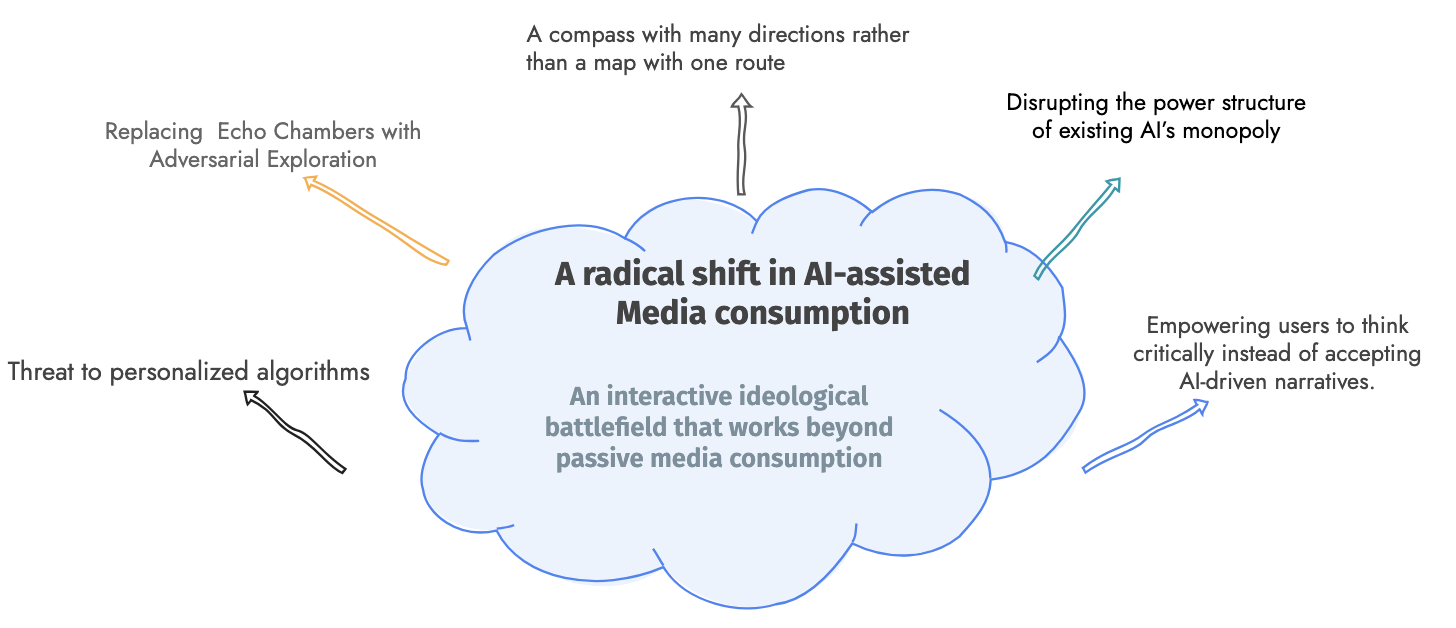
Today's media traps users in "filter bubbles" through personalization algorithms that reinforce ideological isolation by showing content similar to what you've clicked before, which does not allow for exposure to the diverse perspectives that actually exist in complex societies.
AI can help by handling some of this mental processing for us, delivering more digestible insights.
Solution
Multiple ideologically distinct AI "bots" engaging in debates that users can watch live or review in summary form.
e-Agora draws inspiration from Ancient Athens, where decision-making centered on public assemblies where opposing speakers would debate issues. This tool fights single-viewpoint content consumption and breaks through echo chambers by showing users multiple perspectives on exactly what they're reading or thinking about, structured as live debates.
Below is the initial output of what each “faction” would say on the example question of “Is a tomato a fruit or a vegetable?” The user has the option to continue the conversation for as long as they’d like by pressing the bottom buttons to choose who speaks next.

Research
Working through the impossibility of having a neutral AI due to our innate human bias.
We began by wondering if LLMs could be politically "neutral" rather than absorbing biases from their training data. Studies we reviewed show LLMs inevitably acquire political leanings, which is not surprising considering their massive training datasets reflect historical biases (with recent content vastly overrepresented) and information control has always been political by nature. LLMs are biased, but so are all human information sources.
Rather than pursuing the likely impossible goal of a neutral AI, we discovered a more interesting possibility through user interviews and discussions with AI professionals: deliberately creating partisan LLMs that roleplay specific political perspectives.
As we did not have too much time, we worked with the following timeline:

Ideation
Focusing on clarity and distinction between factions.
To avoid triggering strong reactions to politically charged labels and to prevent users from applying their own potentially inaccurate assumptions, we use neutral, less familiar names for our five political factions (Traditionalist, Promethean, Managerialist, Legalist, Liberationist).
This approach is similar to how role-playing games and strategy games label competing philosophies, and it follows academic political theory's practice of using generic terms to identify recurring political themes throughout history.

We recognize there are complex overlaps and nuances across all perspectives, including theological dimensions we haven't addressed. Despite these limitations, we believe our framework represents most political viewpoints within each tradition.

Final Solution
Fighting single-viewpoint content consumption
Each faction will respond in a detailed, passionate, highly specific way and provide historical and novel arguments to defend their positions. At the end, we propose the inclusion of is a section summary of the five and where they agree, disagree, and comments about which faction may care more than others on this issue.
Reflection
The importance of understanding, language, and communication in our ever-changing world.
A short but sweet project! What excited me most about this work was treating understanding different perspectives as a UX problem. For example, the Ancient Agora inspiration wasn't just aesthetic, but rather shaped our core design principle that structured conversation reveals way more than isolated opinions. The goal was that by showing viewpoints in conversation with each other, users could see not just what people think, but why, and where unexpected overlaps exist.
I could not be more grateful to my team for handling with such a complex topic with such grace. This project has deepened my interest in designing systems that help people think more clearly about complex topics, not by simplifying them, but by presenting information in ways that reduce friction and genuinely support understanding!


Diana Chalakova
About
e-AGORA
This collaboration with Cornell Tech is a speculative AI tool that would allow users to break out of echo chambers concerning ideologies. In the team, I was responsible for the entire interface design and crafting the final look of the project.
Roles
UX Design, Web Design, Research
Timeline
Mar – May 2025
(3 months)
Tools
Figma
Problem
How might we make the information ecosystem better support a user’s mental processing?
Today's media traps users in "filter bubbles" through personalization algorithms that reinforce ideological isolation by showing content similar to what you've clicked before, which does not allow for exposure to the diverse perspectives that actually exist in complex societies.
AI can help by handling some of this mental processing for us, delivering more digestible insights.
Solution
Multiple ideologically distinct AI "bots" engaging in debates that users can watch live or review in summary form.
e-Agora draws inspiration from Ancient Athens, where decision-making centered on public assemblies where opposing speakers would debate issues. This tool fights single-viewpoint content consumption and breaks through echo chambers by showing users multiple perspectives on exactly what they're reading or thinking about, structured as live debates.
Below is the initial output of what each “faction” would say on the example question of “Is a tomato a fruit or a vegetable?” The user has the option to continue the conversation for as long as they’d like by pressing the bottom buttons to choose who speaks next.
Research
Working through the impossibility of having a neutral AI due to our innate human bias.
We began by wondering if LLMs could be politically "neutral" rather than absorbing biases from their training data. Studies we reviewed show LLMs inevitably acquire political leanings, which is not surprising considering their massive training datasets reflect historical biases (with recent content vastly overrepresented) and information control has always been political by nature. LLMs are biased, but so are all human information sources.
Rather than pursuing the likely impossible goal of a neutral AI, we discovered a more interesting possibility through user interviews and discussions with AI professionals: deliberately creating partisan LLMs that roleplay specific political perspectives.
As we did not have too much time, we worked with the following timeline:
Ideation
Focusing on clarity and distinction between factions.
To avoid triggering strong reactions to politically charged labels and to prevent users from applying their own potentially inaccurate assumptions, we use neutral, less familiar names for our five political factions (Traditionalist, Promethean, Managerialist, Legalist, Liberationist).
This approach is similar to how role-playing games and strategy games label competing philosophies, and it follows academic political theory's practice of using generic terms to identify recurring political themes throughout history.
We recognize there are complex overlaps and nuances across all perspectives, including theological dimensions we haven't addressed. Despite these limitations, we believe our framework represents most political viewpoints within each tradition.
Final Solution
Fighting single-viewpoint content consumption
Each faction will respond in a detailed, passionate, highly specific way and provide historical and novel arguments to defend their positions. At the end, we propose the inclusion of is a section summary of the five and where they agree, disagree, and comments about which faction may care more than others on this issue.
Reflection
The importance of understanding, language, and communication in our ever-changing world.
A short but sweet project! What excited me most about this work was treating understanding different perspectives as a UX problem. For example, the Ancient Agora inspiration wasn't just aesthetic, but rather shaped our core design principle that structured conversation reveals way more than isolated opinions. The goal was that by showing viewpoints in conversation with each other, users could see not just what people think, but why, and where unexpected overlaps exist.
I could not be more grateful to my team for handling with such a complex topic with such grace. This project has deepened my interest in designing systems that help people think more clearly about complex topics, not by simplifying them, but by presenting information in ways that reduce friction and genuinely support understanding!
Diana Chalakova
About
e-AGORA
This collaboration with Cornell Tech is a speculative AI tool that would allow users to break out of echo chambers concerning ideologies. In the team, I was responsible for the entire interface design and crafting the final look of the project.
Roles
UX Design, Web Design, Research
Timeline
Mar – May 2025 (3 months)
Tools
Figma
Problem
How might we make the information ecosystem better support a user’s mental processing?
Today's media traps users in "filter bubbles" through personalization algorithms that reinforce ideological isolation by showing content similar to what you've clicked before, which does not allow for exposure to the diverse perspectives that actually exist in complex societies.
AI can help by handling some of this mental processing for us, delivering more digestible insights.
Solution
Multiple ideologically distinct AI "bots" engaging in debates that users can watch live or review in summary form.
e-Agora draws inspiration from Ancient Athens, where decision-making centered on public assemblies where opposing speakers would debate issues. This tool fights single-viewpoint content consumption and breaks through echo chambers by showing users multiple perspectives on exactly what they're reading or thinking about, structured as live debates.
Below is the initial output of what each “faction” would say on the example question of “Is a tomato a fruit or a vegetable?” The user has the option to continue the conversation for as long as they’d like by pressing the bottom buttons to choose who speaks next.
Research
Working through the impossibility of having a neutral AI due to our innate human bias.
We began by wondering if LLMs could be politically "neutral" rather than absorbing biases from their training data. Studies we reviewed show LLMs inevitably acquire political leanings, which is not surprising considering their massive training datasets reflect historical biases (with recent content vastly overrepresented) and information control has always been political by nature. LLMs are biased, but so are all human information sources.
Rather than pursuing the likely impossible goal of a neutral AI, we discovered a more interesting possibility through user interviews and discussions with AI professionals: deliberately creating partisan LLMs that roleplay specific political perspectives.
As we did not have too much time, we worked with the following timeline:
Ideation
Focusing on clarity and distinction between factions.
To avoid triggering strong reactions to politically charged labels and to prevent users from applying their own potentially inaccurate assumptions, we use neutral, less familiar names for our five political factions (Traditionalist, Promethean, Managerialist, Legalist, Liberationist).
This approach is similar to how role-playing games and strategy games label competing philosophies, and it follows academic political theory's practice of using generic terms to identify recurring political themes throughout history.
We recognize there are complex overlaps and nuances across all perspectives, including theological dimensions we haven't addressed. Despite these limitations, we believe our framework represents most political viewpoints within each tradition.
Final Solution
Fighting single-viewpoint content consumption
Each faction will respond in a detailed, passionate, highly specific way and provide historical and novel arguments to defend their positions. At the end, we propose the inclusion of is a section summary of the five and where they agree, disagree, and comments about which faction may care more than others on this issue.
Reflection
The importance of understanding, language, and communication in our ever-changing world.
A short but sweet project! What excited me most about this work was treating understanding different perspectives as a UX problem. For example, the Ancient Agora inspiration wasn't just aesthetic, but rather shaped our core design principle that structured conversation reveals way more than isolated opinions. The goal was that by showing viewpoints in conversation with each other, users could see not just what people think, but why, and where unexpected overlaps exist.
I could not be more grateful to my team for handling with such a complex topic with such grace. This project has deepened my interest in designing systems that help people think more clearly about complex topics, not by simplifying them, but by presenting information in ways that reduce friction and genuinely support understanding!